
Well-Being is not a mood. It is not a mystery. It has a structure.
A Structured Path from Ambition to Inner Freedom
A book by Ramesh Srinivasan
Now available on Amazon — Kindle, Paperback, and Hardcover
[https://mybook.to/aNsO16]
About the Book
Why do some people seem genuinely at peace — not because life has been easy, but because something inside them holds steady regardless of what happens?
Most of us navigate the most consequential aspect of our lives — our Well-Being — without a map. We work harder when stressed. We rest only when exhausted. We assume clarity will arrive once circumstances improve. We rarely stop to ask what actually supports a steady, purposeful life — and why some ways of living produce lasting peace while others, despite every effort, do not.
The Geometry of Well-Being offers something rare: a structural framework for understanding how inner life actually works — and how it can grow.
Press
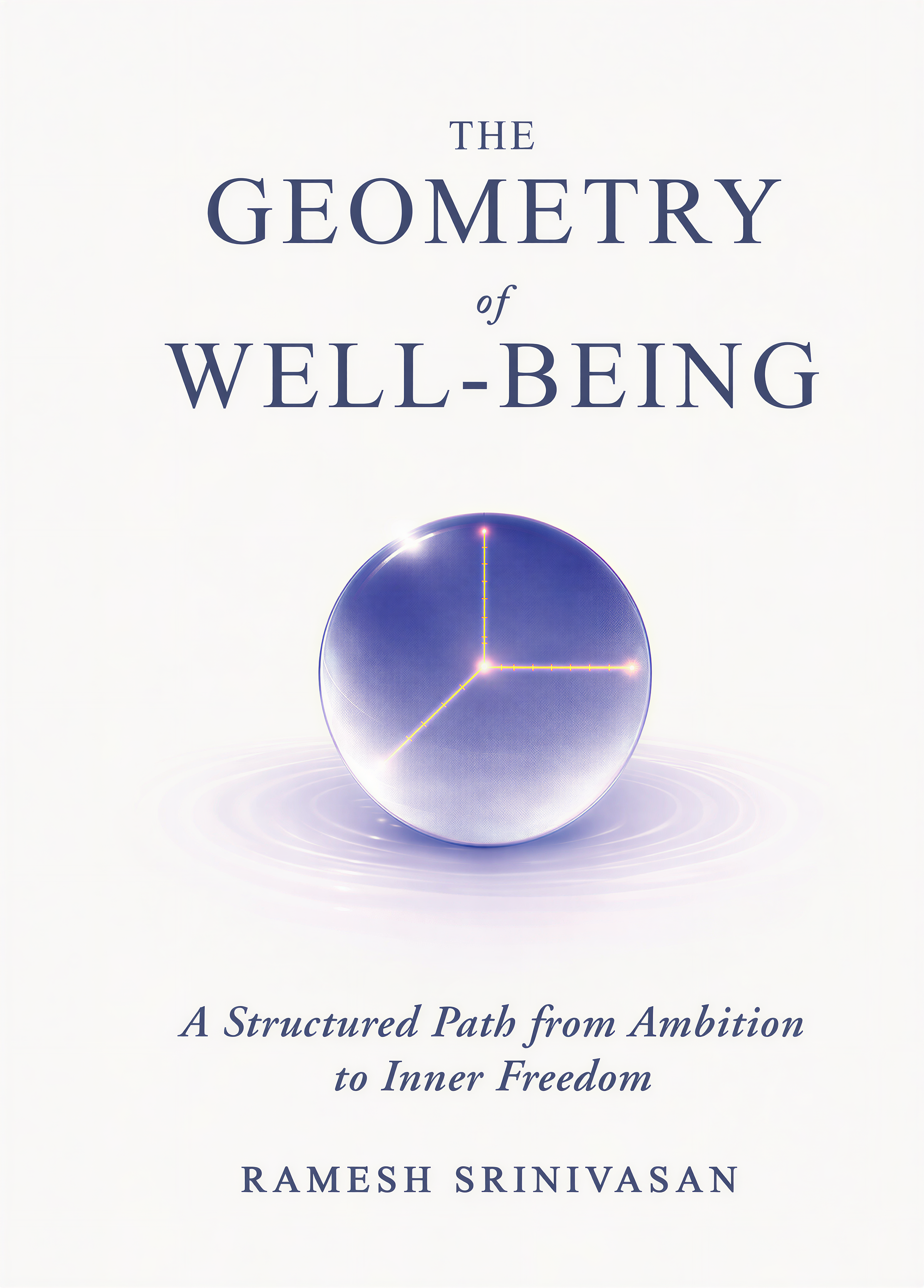
The Geometry of Well-Being
By Ramesh Srinivasan
Genre: Nonfiction / Self-Help / Health & Wellbeing
Reviewed by Madeleine James, Independent Book Review
https://independentbookreview.com/2026/05/19/the-geometry-of-well-being-by-ramesh-srinivasan/
An elegant blueprint for the intellectually rigorous pursuit of resilience and emotional well-being
Ramesh Srinivasan’s debut, The Geometry of Well-Being, offers a unique, mathematical approach to self-help. This singular approach to wellness is an exacting resource for those who flourish within systems-based models.
“We treat Well-Being as a ‘mystery’—something that arrives on good days and evaporates on bad ones. We rely on vague advice to ‘be positive’ or ‘let go.’ We rarely stop to understand the mechanics of why we feel stuck.”
Srinivasan’s geometry removes the mystery from what is commonly seen as a spiritual pursuit. This is a concrete, architectural framework for those who struggle with abstract approaches to mental and emotional health. It’s an engineer’s approach to emotional reliance: “Well-Being is not a mood. It is a geometry. It has dimensions.”
Srinivasan makes a consistent case for this mathematical approach, while ensuring that the reader is amply guided throughout. Each chapter introduces a framework followed by a structured growth map. There is no abstract subjectivity here; instead, there are formulas to engage. “These are not moral rankings or spiritual hierarchies. They are simply states that offer increasing structural integrity.”
The Geometry of Well-Being uses mathematical concepts of length, width, and depth to engage experiences like inertia, ambition, ethics, and contentment as an interlocking system, not just as individual states. By examining how these states interact, the book gradually builds a roadmap you can actually follow. The author finds his analogies in systems-based disciplines that empower us to do this personal work with intellectual rigor.
A standout feature here is the humility of Srinivasan’s authorial voice. We’re not getting a tone that implies rarified expertise. In contrast, Srinivasan is transparent in sharing his own experiences and the inherent need for system’s flexibility. His authority, while not hammering us over the head with proof, is established through a lifelong process of refinement, trial, and error. “I offer this not as a teacher on a pedestal, but as a fellow architect. I found a blueprint that made sense. I offer it here.”
Srinivasan’s concerns are firmly rooted in the reader’s experience. He acknowledges that the process is a long one and that adjustments may be required. The rigor of Srinivasan’s explanations are notable. This is an author who has tools and who is serious about communicating their effective and flexible use.
Ironically, Srinivasan’s earnest pursuit of clarity leads to one of the book’s only stumbling blocks. A great deal of ink and energy are spent explaining the concept in textbook terms. While the information is certainly necessary, its application remains theoretical until the first chapter. There are about thirty pages of preparation that may be mentally exhausting for some.
Happily, the formulas are applied to tangible experiences in the chapters that follow, addressing familiar issues like work-life balance and inertia, at which point the system’s strengths shine. It may have been beneficial to jump into the epilogue, “The Geometry of an Ordinary Life” before embarking on the prologue, but in the end, it’s a minor gripe where the entire framework has already made its mark. The book does an admirable job of illustrating the various stages and moving the reader through them with purpose while the appendices offer a wealth of additional depth.
Aside from thoroughness causing a bit of confusion, The Geometry of Well-Being is a rigorously tested and kindly presented work. It’s an intelligent, thoughtful roadmap to take you from burn-out to resilience, well worth the time and energy.